AI Acceptable Use Policy Template for Small Business (2026 Guide)

If your team uses ChatGPT, Copilot, Gemini or any other AI tool at work, you already need an AI policy. Customers are starting to ask about it in security questionnaires, insurers are asking about it, and staff want to know what is allowed. The good news is that a small business does not need a 60-page framework or a law firm to get started. You need a clear, short AI acceptable use policy that people will actually read, plus a simple way to show they agreed to it.
This guide explains what an AI acceptable use policy template for a small business should include, how to roll one out in about 30 days, and where to get a ready-to-edit version so you are not starting from a blank page.
What is an AI acceptable use policy?
An AI acceptable use policy is a short set of rules that tells employees and contractors how they may use AI tools for company work. It covers which tools are approved, what information must never be typed into them, when a human has to review AI output, and what to do when something goes wrong. Think of it as the AI version of the computer and internet use policy most companies already have.
For a small business, the policy does three jobs at once. It protects customer and company data, it gives staff the confidence to use AI productively instead of secretly, and it gives you a written answer when a client asks, “What is your AI policy?”
Why small businesses need one now
- Your team is already using AI. Most employees try AI tools on their own long before there is a policy. Without rules, client data, contracts or personal information can end up in tools you have never reviewed.
- Customers are asking. Larger clients and government primes increasingly include AI questions in vendor security questionnaires. A written policy turns a vague answer into a confident one.
- It reduces avoidable mistakes. Clear rules on human review and disclosure help prevent AI-generated errors from reaching customers.
- It is cheap to fix early. Writing a policy now takes days. Cleaning up after a data leak takes far longer.
What a good AI acceptable use policy template should include
Whether you write your own or start from a template, check that it covers these areas:
- Purpose and scope. Who the policy applies to (employees, contractors, interns) and which tools it covers, including AI features built into software you already use.
- Approved, conditional and prohibited tools. A simple register that lists which AI tools are approved, which are allowed with limits, and which are not allowed.
- Data rules. The most important section. Spell out which data must never be entered into AI tools, such as customer personal data, health information, passwords, financial details and confidential contracts.
- Human review. When a person must check AI output before it is used, for example anything sent to a customer, published, or used in a decision about a person.
- Disclosure and transparency. When you tell customers or readers that AI helped create something.
- Intellectual property. Who owns AI-assisted work and how to avoid copying protected material.
- Prohibited uses. Clear examples of what is never allowed.
- Exceptions and incident reporting. How to request an exception and how to report a mistake, such as pasting the wrong file into a chatbot.
- Roles and enforcement. Who owns the policy, who approves new tools, and what happens if the rules are broken.
- Acknowledgement and review. A sign-off form for staff and a set review date, because AI tools change quickly.
How to roll out your AI policy in 30 days
A policy only helps if people know about it. Here is a practical plan for a small team:
- Week 1: List the AI tools people already use. A quick survey or team meeting is enough. Screen each tool with a short approval checklist covering what data goes in, what the vendor does with it and how outputs are reviewed.
- Week 2: Customize the policy template to your data types and customer commitments, and fill in your approved tools list.
- Week 3: Have leadership approve it, and have your attorney review it if you work in a regulated industry.
- Week 4: Announce it, run a short 30 to 45 minute training session, and collect signed acknowledgement forms. Set a review date for six or twelve months out.
Common mistakes to avoid
- Banning AI completely. Staff usually keep using it anyway, just without telling you. Clear rules work better than a ban.
- Making it too long. If the policy reads like a legal contract, nobody will finish it. Pair it with a one-page quick guide.
- Skipping the tools list. “Use approved tools only” means nothing if nobody knows which tools are approved.
- Never updating it. New AI features appear constantly. Review the policy at least once a year.
Get a ready-to-edit AI acceptable use policy template
If you would rather not start from scratch, cyhornet.ai has editable templates built for small teams:
- AI Acceptable Use Policy Template (Editable Word), $49: a 12-section policy with a tools register, a 30-day rollout plan, a training outline and an employee acknowledgement form.
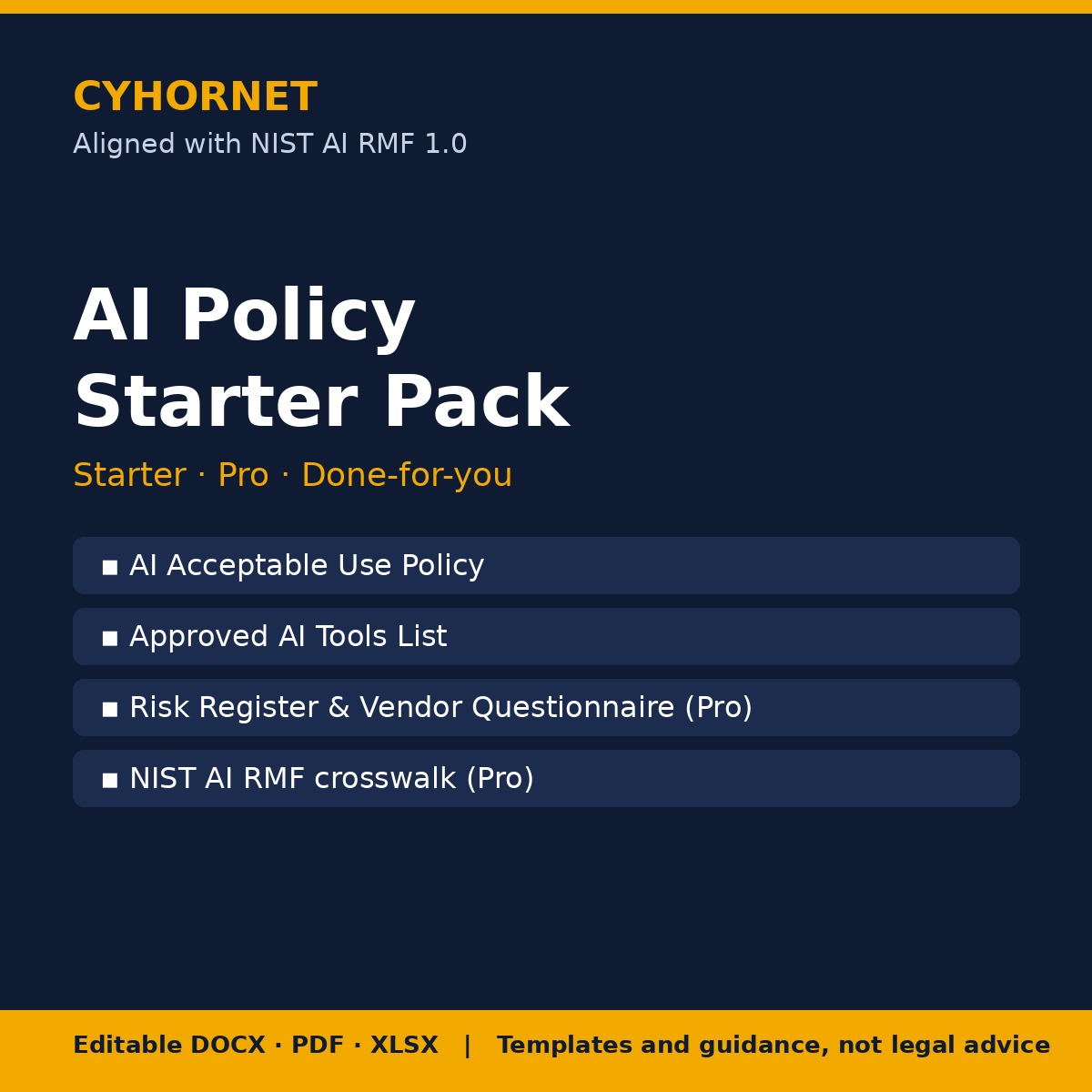
- AI Policy Starter Pack: Starter, $59: a 13-section AI Acceptable Use Policy, an Approved AI Tools List in Excel, an acknowledgement form, a one-page staff quick guide and a customization guide mapped to the NIST AI Risk Management Framework.
- AI Policy Starter Pack: Pro, $129: everything in Starter plus an AI risk register, a vendor due-diligence questionnaire and an AI incident response addendum, for businesses that sell to enterprise or government clients.
Want to start for free? Grab the free AI Tool Approval Quick Checklist to screen tools in week 1, and the free Employee AI Use Acknowledgement Form to collect sign-offs. You can also browse the Cyhornet blog and our 600+ AI Tools Master List.
Frequently asked questions
Does a small business really need an AI policy?
If anyone on your team uses AI tools for work, yes. A short written policy protects customer data, sets expectations for staff and gives you a clear answer when clients ask how you govern AI.
How long should an AI acceptable use policy be?
For most small businesses, around 5 to 10 pages is enough, paired with a one-page quick guide that staff can keep handy.
Is a template the same as legal advice?
No. A template gives you a professionally written starting point, but it is not legal advice and does not certify compliance with any law or framework. Have your attorney review it before adopting, especially in regulated industries.
Which framework should an AI policy follow?
Many organizations use the NIST AI Risk Management Framework (AI RMF 1.0) as a reference because it is free, voluntary and widely recognized. The cyhornet.ai Starter and Pro packs include a NIST AI RMF mapping.
What file format are the cyhornet.ai templates?
The policy templates are editable Microsoft Word files that also open in Google Docs. The Starter and Pro packs add Excel workbooks and PDF copies, delivered instantly as a download.
General information only, not legal advice. Templates do not guarantee compliance with any law, regulation or framework. Cyhornet LLC is not a law firm and is not affiliated with NIST or any government agency.